Hiển thị các bài đăng có nhãn Paul Beckwith. Hiển thị tất cả bài đăng

Chủ Nhật, 31 tháng 5, 2015

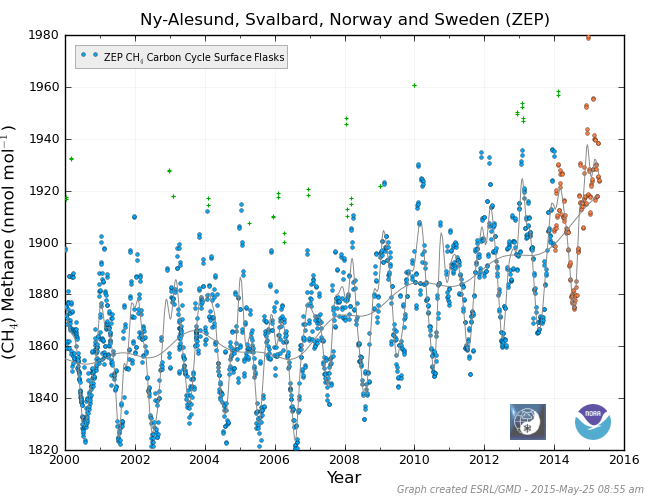
Arctic Methane Skyrocketing

The map below shows observatories in the Arctic.


    'Arctic methane skyrocketing' is the title of a video by Paul Beckwith discussing recent rises in methane levels in the Arctic.


    Paul's description: "I discuss how ground level flask measurements of methane have been spiking upwards over the last few years. I analyze the implications to the breakdown of climate stability, causing jet stream fracturing and weather regime change. I believe that this behaviour will rapidly worsen as Arctic temperature amplification continues, leading our planet to a much warmer and unrecognizable climate over the next 5 to 10 years."

    Below are some NOAA images showing methane levels (surface flasks) recorded at Arctic observatories.


    Below is an image showing hourly average in situ measurements at Barrow, Alaska, including one very high reading, from an earlier post.


    The image below shows sea surface temperature anomalies in the Arctic on May 30, 2015.


    The situation is dire and calls for comprehensive and effective action, as discussed at the Climate Plan page.


    Sea surface temperature anomalies in the Arctic on May 30, 2015. From the post: 'Arctic Methane Skyrocketing' http://arctic-news.blogspot.com/2015/05/arctic-methane-skyrocketing.html

    Posted by Sam Carana on Sunday, May 31, 2015

    Thứ Ba, 14 tháng 10, 2014

    Royal Society snubs important Arctic scientists and their research

    by Dorsi Diaz

    Nick Breeze interview with East Siberian Arctic Shelf researcher (ESAS) Dr. Natalia Shakhova on why the important news about methane news is not reaching mainstream news. Powerful interests seem to be in the way of Arctic methane education.

    A few days ago an important Royal Society meeting took place that presented important research on the current state of the Arctic. Called ‘Arctic sea ice reduction: the evidence, models, and global impacts’, the event was held in London, England. It was advertised as a “Scientific discussion meeting organised by Dr Daniel Feltham, Dr Sheldon Bacon, Dr Mark Brandon and Professor (Emeritus) Julian Hunt FRS.”

    Powerful interests seem to be standing in the way of
    important research on 
    methane and a dwindling Arctic.
    Nick Breeze, Dorsi Diaz
    The presenters and attendees there included a list of over 200 important climate scientists from different parts of the world. One could assume from the list of workshops that this conference was being held to talk about and discuss the critical loss of ice we are seeing in the Arctic, and that the purpose of the meeting would be to include any and all data relevant to this never-before-seen-in-human-history event.

    People following the rapid loss of Arctic ice and all that data could even be forgiven for feelings of excitement and hope that at least someone is ‘working on it’. We could have assumed that communication was one of the goals here, especially since the conference was tweeted widely, even from inside the conference. Following those tweets we could also have assumed that it was intended that people in the conference were to share information that was important not only about climate change but the loss of the Arctic sea ice.

    Such a conference sounds like a great idea, doesn't it? We could have a cause for hope and the organizers seemed transparent, even going so far as to tweet plans. But such assumptions and presumptions would have been misplaced. Instead, what happened has turned into what has been called a Royal Society snubbing of scientists: a brouhaha has developed both in scientific circles and the world wide web, and has now raised serious questions. The main issue was that cutting edge scientists Dr Shakhova and Dr Semiletov were not even invited to present or discuss their very recent findings on important Arctic sea ice and methane releases.

    Who are they and what did they have to offer to this conference? Perhaps it was an ‘accident’ that they were not invited? Maybe they were just not on the guest list? Or, if they were deliberately not invited, what could be the reason?

    As it turns out Dr Shakhova & Dr Semiletov had just returned from a crucial expedition to the Arctic. The Swerus C3 expedition was conveyed aboard the icebreaker Oden. The goal was to gather data about the Arctic, in particular concerning methane hydrates and systems interaction.

    Arctic Expedition

    Martin Jakobsson, Professor at Stockholm University and chief scientist on Leg 2, says: “SWERUS-C3 is a two-leg Swedish-Russian-US cooperation that will investigate the linkages between climate, the cryosphere, and carbon. Leg one of the expedition departed from Tromsø, Norway, on 5 July and travelled along the Russian Arctic coast to reach Barrow, Alaska, where a change-over of research staff and crew took place on 20 August. On 21 August SWERUS-C3 set off for its return journey back to Tromsø, this time over the Lomonosov Ridge, an underwater mountain range.”

    Jakobsson continues: “During the expedition's second leg we studied the warm Atlantic water that flows into the Arctic Ocean and pockmarks at 900-meter depths as well as the enormous tracks on the ocean floor left by previous ice sheets found in the central Arctic Ocean. The material will be able to provide new perspectives on Arctic sea ice development and history as well as stability of gas hydrates along the Arctic continental shelf.”

    Findings in the Arctic have not been particularly reassuring; in fact they portend a dire scenario. A press release from University of Stockholm described that they discovered: “Vast methane plumes escaping from the seafloor of the Laptev continental slope. These early glimpses of what may be in store for a warming Arctic Ocean could help scientists project the future releases of the strong greenhouse gas methane from the Arctic Ocean.”

    This could all be read as some mere diplomatic or career-based tussle among scientists, or some type of television drama happening at an obscure conference of less-than household names, so why would the average reader be interested in what this has to do with life on earth?

    It does have everything to do with every being that inhabits this planet. To put it into context: Arctic events are turning into a planetary emergency and are developing as you read. Key is the full meltdown of Arctic sea ice, akin to our planetary air conditioner going kaput. Please see the startling Arctic Death Spiral photo here to check just how little Arctic ice is left: Arctic Death Spiral 1979-2013 ( Sea Ice Decline / Deglaciation)

    Key words: Planetary emergency

    A recent article in USA Today entitled Study: Earth in the midst of sixth mass extinction states: “The loss and decline of animals around the world — caused by habitat loss and global climate disruption — mean we're in the midst of a ‘sixth mass extinction’ of life on Earth, according to several studies out Thursday in the journal Science. One study found that although the human population has doubled in the past 35 years, the number of invertebrate animals – such as beetles, butterflies, spiders and worms – has decreased by 45% during that same period.” Simple Google searches on this topic allow one to uncover a recent addition of many such articles on the same topic.

    To be clear, I have the utmost respect for the scientific community and what they have contributed to the advancement of science. I have interviewed some, and helped give voice to the work of scientists, professors, teachers. and experts: I believe in open communication. I believe that when there is a huge problem as in this case of our planetary emergency or ‘6th mass extinction event’, we need all hands on deck, especially the ones out there on the front lines. Dr Shakhova & Dr Semiletov are two of these.

    According to computer modelling, our ‘Arctic air conditioner’ was supposed to stay intact and run effectively for many years. Previously the year 2100 was said to have been the year we would really see all ‘he##’ break loose. Now we realize that those models were way off. In fact, our ‘air-conditioner’ is self-destructing more every minute, causing a meandering jet stream which is already reeking climate havoc around the world: typhoons, hurricanes, tornadoes, and other such catastrophic climate events are more commonplace. Indeed, climate change has already become downright nasty. What we were told would not happen until much later is actually taking place right now.

    Scientists and governments realize we have a great big problem and have started doing lots and lots of research into our ‘Arctic air conditioner’. Experts were sent to view the problem, Dr Shakhova & Dr Semiletov on board, and told to report back their findings.

    The Problem

    The air conditioning experts that were sent to check on the problem were not invited to address the Royal Society event to report back, nor to even discuss the air conditioner break down. To be fair, some of them were called upon, including Professor Peter Wadhams (although other significant issues arose to do with Prof Wadhams too). However, the only reporting scientists who were called upon to report on the problem were those same who have been using those same types of conservative computer modeling methods that have traditionally proved to be seriously behind the time actual timeline followed by the Arctic ice.

    Clearly it is has been safe to say for years now that those computer modeling methods are more conservative than accurate, and are now in fact far and away off the mark of accuracy. Even a non-scientist can clearly see there is a deeply serious divide between the predictions of conservative models and the dramatic melting events of current days.

    The Royal Society plans a ‘communicative’ conference on Arctic sea-ice and leaves out experts recently returned from a life-threatening expedition specifically to review the problem. Meanwhile, others in comfortable office chairs merely crunch data for help guessing at possible problem scenarios. To whom would you listen? Would you trust just one expert or would you call on as many experts as possible to pool resources? Do you feel safe just listening to one side of the story without real-world observations, data, and discussion being included?

    created by Zaven Ohannessian with screenshot from interview with Dr. Natalia Shakhova, by Nick Breeze

    Imagine for a minute that you are Shakhova and her colleagues. You have been sent to view and report back on the broken air conditioner. You have observed rapid and almost unbelievable changes taking place on your expeditions. It is falling apart and leaking methane. You know that methane is many times more potent and powerful than carbon dioxide and can cause way more damage to the earth if lots of it are coming out. In fact, you have not seen such massive changes before on numerous previous expeditions. You are deeply concerned and really need to let others involved with the ‘Arctic air conditioner’ know what you have seen.

    But, when a chance to talk about your data and observations comes up, you are not invited. The very important meeting goes on without you and nothing that you have seen, documented, and observed will become public knowledge. You are stunned by this snub. You want to be able to tell them and therefore the world what is going on. You want to get this information out so that they will let others know what is happening to our ‘Arctic air conditioner’ and the symptoms that its melt are causing.

    I can only imagine how that must have felt, sitting on this newest and very important data and not being able to share. Politely though, Dr Shakhova writes a letter about her exclusion, and asks to be able to present her data and observations. She sends a letter to Sir Paul Nurse at the Royal Academy (via climate communication journalist Nick Breeze):

    October 4th, 2014
    By mail and email

    Dear Sir Paul Nurse,

    We are pleased that the Royal Society recognizes the value of Arctic science and hosted an important scientific meeting last week, organised by Dr D. Feltham, Dr S. Bacon, Dr M. Brandon, and Professor Emeritus J. Hunt (https://royalsociety.org/events/2014/arctic-sea-ice/).

    Our colleagues and we have been studying the East Siberian Arctic Shelf (ESAS) for more than 20 years and have detailed observational knowledge of changes occurring in this region, as documented by publications in leading journals such as Science, Nature, and Nature Geosciences. During these years, we performed more than 20 all-seasonal expeditions that allowed us to accumulate a large and comprehensive data set consisting of hydrological, biogeochemical, and geophysical data and providing a quality of coverage that is hard to achieve, even in more accessible areas of the World Ocean.

    To date, we are the only scientists to have long-term observational data on methane in the ESAS. Despite peculiarities in regulation that limit access of foreign scientists to the Russian Exclusive Economic Zone, where the ESAS is located, over the years we have welcomed scientists from Sweden, the USA, The Netherlands, the UK, and other countries to work alongside us. A large international expedition performed in 2008 (ISSS-2008) was recognized as the best biogeochemical study of the IPY (2007-2008). The knowledge and experience we accumulated throughout these years of work laid the basis for an extensive Russian-Swedish expedition onboard I/B ODEN (SWERUS-3) that allowed more than 80 scientists from all over the world to collect more data from this unique area. The expedition was successfully concluded just a few days ago.

    To our dismay, we were not invited to present our data at the Royal Society meeting. Furthermore, this week we discovered, via a twitter Storify summary (circulated by Dr. Brandon), that Dr. G. Schmidt was instead invited to discuss the methane issue and explicitly attacked our work using the model of another scholar, whose modelling effort is based on theoretical, untested assumptions having nothing to do with observations in the ESAS. While Dr. Schmidt has expertise in climate modelling, he is an expert neither on methane, nor on this region of the Arctic. Both scientists therefore have no observational knowledge on methane and associated processes in this area. Let us recall that your motto “Nullus in verba” was chosen by the founders of the Royal Society to express their resistance to the domination of authority; the principle so expressed requires all claims to be supported by facts that have been established by experiment. In our opinion, not only the words but also the actions of the organizers deliberately betrayed the principles of the Royal Society as expressed by the words “Nullus in verba.”

    In addition, we would like to highlight the Anglo-American bias in the speaker list. It is worrisome that Russian scientific knowledge was missing, and therefore marginalized, despite a long history of outstanding Russian contributions to Arctic science. Being Russian scientists, we believe that prejudice against Russian science is currently growing due to political disagreements with the actions of the Russian government. This restricts our access to international scientific journals, which have become exceptionally demanding when it comes to publication of our work compared to the work of others on similar topics. We realize that the results of our work may interfere with the crucial interests of some powerful agencies and institutions; however, we believe that it was not the intent of the Royal Society to allow political considerations to override scientific integrity.

    We understand that there can be scientific debate on this crucial topic as it relates to climate. However, it is biased to present only one side of the debate, the side based on theoretical assumptions and modelling. In our opinion, it was unfair to prevent us from presenting our more-than-decadal data, given that more than 200 scientists were invited to participate in debates. Furthermore, we are concerned that the Royal Society proceedings from this scientific meeting will be unbalanced to an unacceptable degree (which is what has happened on social media).

    Consequently, we formally request the equal opportunity to present our data before you and other participants of this Royal Society meeting on the Arctic and that you as organizers refrain from producing any official proceedings before we are allowed to speak.

    Sincerely,
    On behalf of more than 30 scientists,
    Natalia Shakhova and Igor Semiletov

    Voicing concerns

    Among concerned people following this closely is part-time Professor Paul Beckwith, PhD student of abrupt climate change. Beckwith offers his concerns on this latest turn of events at the Royal Society in his newest video: A little chat on methane

    Beckwith’s latest statement about his overall assessment of the Arctic situation and where we stand is not particularly comforting either: Our climate system is presently undergoing preliminary stages of abrupt climate change. If allowed to continue, the planetary climate system is quite capable of undergoing an average global temperature increase of 5°C to 6°C over a decade or two. Precedence for changes at such a large rate can be found at numerous times in the paleo-records. From my chair, I conclude that it is vital that we slash greenhouse gas emissions and undergo a crash program of climate engineering to cool the Arctic region and keep the methane in place in the permafrost and ocean sediments.”

    Beckwith points at research in the U.S., such as a study published in 2012 by Lawrence Livermore Laboratory researchers who sum up the situation as follows: “The question is not whether but how much and how quickly methane will be released due to warming, and whether it will be enough to trigger a runaway feedback loop.” The study, earlier discussed at the Arctic-news blog, concludes: “In our review of Arctic methane sources, we found that significant gaps in understanding remain of the mechanisms, magnitude, and likelihood of Arctic methane release. No authors stated that catastrophic release of methane—e.g., hundreds of Gt over years to decades—is the expected near-term outcome. But until the mechanisms are better-understood, such a catastrophe cannot be ruled out. The evidence is strong that methane had a role in past warming events, but the particular source and release mechanisms of methane in past warming is not settled. Whereas most authors indicated that a catastrophic release is unlikely, a chronic, climatically significant release of Arctic methane appears plausible. Such a release could undermine or overwhelm gradual emissions reductions made elsewhere, and thus warrants technological intervention.”

    Beckwith further points at paper by 21 Russian scientists, including Shakhova and Semiletov, who sum up the situation as follows: “The emission of methane in several areas of the East Siberian Shelf is massive to the extent that growth in the methane concentrations in the atmosphere to values capable of causing a considerable and even catastrophic warming on the Earth is possible.”

    In the meantime, we wait with anticipation to see what the U.K. Royal Society's response will be, and if we will be able to hear of Shakhova and Semiletov's latest data and observations on the state of the Arctic. I, for one, would like to know everything about how the ‘Arctic air conditioner’ is really doing; wouldn't you?

    Planetary Emergency Update

    As I write the text above, a new article is released: “It’s Worse Than We Thought” — New Study Finds That Earth is Warming Far Faster Than Expected. A small excerpt: “Earlier this week, a new study emerged showing that the world was indeed warming far faster than expected. The study, which aimed sensors at the top 2,000 feet of the World Ocean, found that waters had warmed to a far greater extent than our limited models, satellites, and sensors had captured. In particular, the Southern Ocean showed much greater warming than was previously anticipated.”

    Many thanks to Julian Warmington, Associate Professor at BUFS, Busan University of Foreign Studies, for editing this news report.

    Related

    Climate Change: Paul Beckwith discusses the threat of methane
    Dr. Malcolm Light interview on climate change: 'Extreme national emergency'
    Special presentations on climate change and its effects by Dr. Guy McPherson


    Thứ Bảy, 11 tháng 10, 2014

    Climate Change Accelerating

    Methane levels as high as 2562 ppb were recorded on October 9, 2014, as illustrated by the image below.

    Many grey areas show up in the image where QC (quality control) failed, as it was too hard to read methane levels in the respective area, apparently due to high moisture levels (i.e. snow, rain or water vapor) in the atmosphere.


    As above image illustrates, cloud cover is high over the Arctic, while there is also precipatation in the form of snowfall.

    In other words, high levels of methane (above 1950 ppb, colored yellow) could be present over a much larger part of the Arctic Ocean, while methane in these grey areas could be even higher than the measured peak level of 2456 ppb.

    This appears to be confirmed by persistent high methane levels over vast areas across the Arctic Ocean both in the morning (top part of the image further above) and in the afternoon (bottom part of image) on 9 October 2014.

    Methane levels are this high over the Arctic Ocean for the number of reasons, including:
    • The Gulf Stream keeps pushing warm water into the Arctic Ocean.
    • The resulting eruptions of methane from the seafloor of the Arctic Ocean constitute a feedback that accelerates warming in the Arctic. 
    • As the Arctic warms up more rapidly than the rest of Earth, the Arctic's ice and snow cover will decline, further accelerating warming in the Arctic.
    • As the Arctic warms up more rapidly than the rest of Earth, the speed at which jet streams circumnavigates the Northern Hemisphere will weaken, making it meander more, resulting in a greater frequency and intensity of extreme weather events, such as heat waves, droughts and wildfires. 
    Here's an example of intense warming. Look at what is currently happening on Greenland.

    As the image above right shows, sea surface temperature anomalies as high as +1.89°C hit the North Atlantic (on October 8, 2014). 

    Furthermore, high cloud cover over the Arctic (image further above) makes it hard for the heat there to radiate out into space, further contributing to high temperature anomalies.

    The image on the right shows high temperature anomalies over Greenland and parts of the Arctic Ocean on October 11, 2014. Note that anomalies are averaged out over the course of the day (and night).

    The image below (right) shows anomalies at the top end of the scale hitting large parts of Greenland at a specific time during this day. The left part of the image below shows how this could happen, i.e. jet streams curling around Greenland trapping warm air inflow from the North Atlantic.


    As said, as the Arctic warms up more rapidly than the rest of Earth, the speed at which jet streams circumnavigate the Northern Hemisphere will weaken, making the jets meander more and creating patterns that can trap heat (or cold) for a number of days over a given area. Due to the height of its mountains, Greenland is particularly prone to be increasingly hit by heatwaves resulting from such blocking patterns. Warming changes the texture of snow and ice, making it more slushy and darker, which also makes that it absorbs more of the sunlight's heat, further accelerating melting.

    As Paul Beckwith warns in an earlier post, melt rates on Greenland have doubled in the last 4 to 5 years, and melt rates on the Antarctica Peninsula have increased even faster. Based on the last several decades, melt rates have had a doubling period of around 7 years or so. If this trend continues, we can expect a sea level rise approaching 7 meters by 2070.

    From: More than 2.5 m sea level rise by 2040
    These are all indications that the pace of climate change is accelerating in many ways, the most dangerous one being ever larger methane eruptions from the Arctic Ocean's seafloor. As the image below shows, sea surface temperature anomalies are very high in the Arctic Ocean, indicating very high temperatures under the surface.


    U.S. Secretary of State John Kerry recently said: “There are now – right now – serious food shortages taking place in places like Central America because regions are battling the worst droughts in decades, not 100-year events in terms of floods, in terms of fires, in terms of droughts – 500-year events, something unheard of in our measurement of weather.” Warning about looming catastrophe, Kerry adds: “Life as you know it on Earth ends. Seven degrees increase Fahrenheit (3.9°C), and we can't sustain crops, water, life under those circumstances.”

    The situation is dire and calls for comprehensive and effective action, as discussed at the Climate Plan blog.


    Thứ Sáu, 3 tháng 10, 2014

    Where we are - A climate system summary

    by Paul Beckwith


    Air


    The presence of GHGs (greenhouse gases) in the atmosphere is vital to sustain life on our planet. These GHGs trap heat and keep the global average surface temperature of the planet at about 15°C, versus a chilly -18°C, which would be our temperature without the GHGs.

    We have changed the chemistry of the atmosphere, specifically of the concentrations of the GHGs. Concentrations of carbon dioxide have increased about 40% since the start of the industrial revolution (from a tight range between 180 to 280 ppm over at least the last million years) to 400 ppm. Concentrations of methane have increased by more than 2.5x since the start of the industrial revolution (from a tight range of 350 to 700 ppb) to over 1800 ppb. The additional heat trapped has warmed our planet by over 0.8°C over the last century, with most of that rise (0.6°C) occurring in the last 3 or 4 decades.

    Oceans

    Over 90% of the heat trapped on the surface of the planet is increasing the temperature of the ocean water. The increased levels of carbon dioxide in the atmosphere acidify the rainfall, and have increased the acidity of the oceans by about 40% in the last 3 to 4 decades (pH of the open ocean has dropped from 8.2 down to 8.05 on the logarithmic scale). An increased drop to a pH of 7.8 will prevent calcium based shells from forming, and threaten the entire food chain of the ocean. Changes in ocean currents, and vertical temperature profiles are leading to more stratification and less overturning which is required to transport nutrients to the surface for phytoplankton to thrive.

    Global sea levels are presently rising at a rate of 3.4 mm per year, compared to a rate of about 2 mm per year a few decades ago. Melt rates on Greenland have doubled in the last 4 to 5 years, and melt rates on the Antarctica Peninsula have increased even faster. Based on the last several decades, melt rates have had a doubling period of around 7 years or so. If this trend continues, we can expect a sea level rise approaching 7 meters by 2070.

    From: More than 2.5 m sea level rise by 2040
    Land

    Higher global average temperatures have increased the amount of water vapor in the atmosphere by about 4% over the last several decades, and around 6% since the start of the industrial revolution. Changes in heat distribution with latitude from uneven heating with latitude has slowed the jet streams and caused them to become wavier and fractured, and has changed the statistics of weather. We now have higher frequencies, intensities, and longer duration extreme weather events and also a change in location of where these events occur.

    Feedback loops

    The sensitivity of the climate system to increased levels of GHG appears to be much higher than previously expected due to many powerful reinforcing feedbacks.

    From: Arctic Warming due to Snow and Ice Demise

    Arctic temperature amplification from exponentially declining sea ice and spring snow cover are the strongest feedbacks in our climate system today. The average albedo (reflectivity) of the Arctic region has decreased from 52% to a present day value of 48% over 3 or 4 decades. The increased absorption of energy in the Arctic has increased the temperature at high latitudes at rates up to 6 to 8x the global average temperature change. The reduced temperature difference between the Arctic and equator has reduced the west to east speed of the jet streams causing them to slow and become wavier and more fractured, and directly causing a large change in the statistics of our global weather.

    Methane gas emissions have been rapidly rising in the Arctic region from the terrestrial permafrost and the continental shelf marine sediments, most notably on the ESAS (Eastern Siberia Arctic Shelf). The extremely potent ability of methane to warm the planet (global warming potential GWP is >150, 86, and 34 times for methane relative to carbon dioxide on a few year, several decade, and century timescale, respectively) makes increased emissions an extremely dangerous risk to our well-being on the planet.

    My overall assessment

    Our climate system is presently undergoing preliminary stages of abrupt climate change. If allowed to continue, the planet climate system is quite capable of undergoing an average global temperature increase of 5°C to 6°C over a decade or two. Precedence for changes at such a large rate can be found at numerous times in the paleo-records. From my chair, I conclude that it is vital that we slash greenhouse gas emissions and undergo a crash program of climate engineering to cool the Arctic region and keep the methane in place in the permafrost and ocean sediments.


    Paul Beckwith
    Paul Beckwith is part-time professor with the laboratory for paleoclimatology and climatology, department of geography, University of Ottawa. Paul teaches climatology/meteorology and does PhD research on 'Abrupt climate change in the past and present'. Paul holds an M.Sc. in laser physics and a B.Eng. in engineering physics and reached the rank of chess master in a previous life. Click here to view Paul's earlier posts at the Arctic-news blog.


    Related

    - What's wrong with the weather?
    http://arctic-news.blogspot.com/2014/07/whats-wrong-with-the-weather.html

    - Arctic News: Polar jet stream appears hugely deformed
    http://arctic-news.blogspot.com/2012/12/polar-jet-stream-appears-hugely-deformed.html


    Thứ Bảy, 5 tháng 4, 2014

    Escalating extreme weather events to hammer humanity


    By Paul Beckwith

    Extreme weather events are rocketing upwards in their frequency of occurrence, intensity, and duration and are impacting new regions that are unprepared. These events, such as torrential rains, are causing floods and damaging crops and infrastructure like roads, rail, pipelines, and buildings. Cities, states, and entire countries are being battered and inundated resulting in disruption to many peoples lives as well as enormous economic losses. As bad as this is, it is going to get much worse by at least 10 to 20 times. Why?

    Greenhouse gas emissions from humans have changed the chemistry of the atmosphere. The optical absorption of infrared heat has increased in the atmosphere which raises temperature, and thus water vapor content, and therefore fuels more intense storms. The jet streams that guide these storms are slower and wavier and more fractured and cause our weather gyrations and weird behavior. Areas far north can get very warm, while areas far south can get very cold. Some areas get persistent drought. Then, the pattern can flip. The jet streams are much wavier in the north-south direction since the Arctic temperatures have warmed 5 to 8 times faster than the global average. This reduces the temperature difference between the Arctic and equator and basic physics forces the jets to slow and get wavier.

    Why is the Arctic warming greatly amplified? The region is darkening and thus absorbing more sunlight, since the land-based snow cover in spring and the Arctic sea ice cover volume are both declining exponentially. The white snow and ice is being replaced by dark surfaces like the ocean and the tundra. The most detailed computer model on sea ice decline is a U.S. Naval Graduate School model, and it shows the sea ice cover could be gone by late summer in 2016. If this happens, the Arctic warming will rocket upwards, the jets will distort much more, and the extreme weather events will rocket upwards in frequency, amplitude, and duration and civilization will be hammered.


    Paul Beckwith
    Paul Beckwith is part-time professor with the laboratory for paleoclimatology and climatology, department of geography, University of Ottawa. Paul teaches climatology/meteorology and does PhD research on 'Abrupt climate change in the past and present'. Paul holds an M.Sc. in laser physics and a B.Eng. in engineering physics and reached the rank of chess master in a previous life. Below are Paul's earlier posts at the Arctic-news blog.


    Paul Beckwith with sign (arrows highlighted by 
    Sam Carana, from earlier post)

    Below, a recent video in which Paul Beckwith discusses how a weaker Jet Stream lets warmer air move from lower latitudes into the Arctic (feedback #10).


    From December, 2013 until early April, 2014 there have been persistent and very large temperature anomalies in the northern hemisphere (+20 C = +36 F in the Arctic, -20 C = -36 F in vast parts of the US and Canada). I claim that this represents a previously unrecognized large positive feedback acting to homogenize the temperature in the northern hemisphere.


    Earlier posts by Paul Beckwith

    - Abrupt Climate Change

    - Our New Climate and Weather - part 2

    - Our New Climate and Weather

    - Are Alberta’s Tar Sands prepared for a torrential rain event?

    - Stop All New Fossil Fuel Megaprojects

    - Toward Genuinely Improved Discussions of Methane & Climate

    - The Social Tipping Point

    - Arctic Cyclone July 2013

    - Arctic Ocean Events - Videos by Paul Beckwith

    - Climate change fighting town savaged by runaway oil train

    - Extreme weather becomes the norm - what can you do?

    - Thin Spots developing in Arctic Sea Ice

    - The Tornado Connection to Climate Change

    - Anthropogenic Arctic Volcano can calm climate

    - Hold on folks… the times they are a-changin’

    - Hurricane Sandy moving inland

    - Open Letter to Canadian MPs

    - State of Climate Change October 2012

    - Is death by lead worse than death by climate? No.

    - You are now entering the nonlinearity zone…

    - Vanishing Arctic sea ice is rapidly changing global climate

    - Storm enters Arctic region

    - Update on September Arctic cyclone

    - Arctic cyclone warning for September 7

    - Paul Beckwith on ice speed and drift - update 1

    - Paul Beckwith on ice speed and drift

    - Another Arctic Cyclone brewing

    - Sea ice in the Arctic - Shaken and stirred (by a powerful cyclone)

    - How to part ways with a climate denier that has incredible stamina...


    Thứ Bảy, 1 tháng 2, 2014

    Abrupt Climate Change - by Paul Beckwith

    by Paul Beckwith

    Humans have benefited greatly from a stable climate for the last 11,000 years - roughly 400 generations. Not anymore. We now face an angry climate. One that we have poked in the eye with our fossil fuel stick and awakened. Now we must deal with the consequences. We must set aside our differences and prepare for what we can no longer avoid. And that is massive disruption to our civilizations.

    In a nutshell, the logical chain of events occurring is as follows:
    1. Greenhouse gases that humans are putting into the atmosphere from burning fossil fuels are trapping extra heat in the earth system (distributed between the oceans (93%), the cryosphere (glaciers, ice sheets, sea ice for 3%), the earth surface (rocks, vegetation, etc. for 3%) and the atmosphere (only an amazingly low 1%). The oceans clearly get the lions share of the energy, and if that 1% heating the atmosphere varies there can be decades of higher or lower warming, as we have seen recently. This water vapor rises and cools condensing into clouds and releasing its stored latent heat which is increasing storm intensity.
    2. (i)Rapidly declining Arctic sea ice (losing about 12% of volume per decade) and (ii)snow cover (losing about 22% of coverage in June per decade) and (iii)darkening of Greenland all cause more solar absorption on the surface and thus amplified Arctic warming (global temperatures have increased (on average) about 0.17oC per decade, the Arctic has increased > 1oC per decade, or about 6x faster)
    3. Equator-to-Arctic temperature difference is thus decreasing rapidly
    4. Less heat transfer occurs from equator to pole (via atmosphere, and thus jet streams become streakier and wavier and slower in west-to-east direction, and via ocean currents (like Gulf Stream, which slows and overruns continental shelf on Eastern seaboard of U.S.)
    5. Storms (guided by jet streams) are slower and sticking and with more water content are dumping huge torrential rain quantities on cities and widespread regions at higher latitudes than is “normal”.
    6. A relatively rare meteorological event called an “atmospheric river” is now much more common, and injects huge quantities of water over several days to specific regions, such as Banff (with water running downhill to Calgary) and Toronto and Colorado events.
    The above is extracted from one of Paul's earlier posts.

    Paul discusses more details in the videos below. Our abruptly changing climate system: where we are and where we are going.

    Abrupt Climate Change - part 1


    And the next part, Abrupt Climate Change - part 2


    Extreme weather is like a sledgehammer repeatedly pounding away at the inaction, lethargy, and climate change denial that is prevalent in rich Western countries around the world.

    Inevitably, the hammer pounding will increase in frequency, severity, duration, and spatial extent over the next few years until the denial crumbles, in spite of the annual one billion dollars in fossil fuel money that is paid to support fraud by hiding the truth on the threat that we all face. 

    A tipping point in collective societal behaviour will occur, and humanity will finally initiate action, albeit frantically, to begin to deal with the largest problem ever faced in our history.


    Paul Beckwith is a part-time professor with the laboratory for paleoclimatology and climatology, department of geography, University of Ottawa. He teaches second year climatology/meteorology. His PhD research topic is “Abrupt climate change in the past and present.” He holds an M.Sc. in laser physics and a B.Eng. in engineering physics and reached the rank of chess master in a previous life.

    Thứ Hai, 27 tháng 1, 2014

    Our New Climate and Weather - part 2


    by Paul Beckwith

    continued from part 1

    In North America we are about to experience a late January, 2014 weather event that will likely go down in the record books, at least for a few weeks until the next event. Such is life on our rapidly changing planet in Climate 2.0, or perhaps this would better be called the great abrupt climate change transition between Climate 1.0 (our old climate) and the new, much warmer Climate 2.0.

    In any event, the jet stream is configuring into that two crest/two trough mode that I discussed above. An enormous plug of cold Arctic air is descending southward across North America with temperature anomalies 20 degrees C below normal (36 degrees F below normal). It likely reaches far enough south to enter into northern Mexico and to cover large parts of Florida and extend out into the Gulf of Mexico and the Atlantic, resulting in northern Florida dropping below freezing (see my YouTube video below).

    For more commentary on above video, see the post Deep Freeze and Abrupt Climate Change

    Meanwhile, in turn, almost the entire Arctic region is seeing huge positive temperature anomalies that are 20 degrees C above normal (36 degrees F above normal). This air is changing the Arctic circulation patterns, and although the Arctic air temperature is still below zero, it is so much warmer than normal that the thickening and area growth of sea ice is being severely curtailed. There is strong ice motion out of the Fram Strait between Greenland and Svalbard which is carrying some of the thickest ridged ice just north of the Canadian archipelago out to warmer water and destruction. In the Bering Strait the ice motion is switching between transport of warm Pacific Ocean water into the Arctic Ocean and export of cold Arctic Ocean water out into the Pacific, leading to less ice formation outside the strait.


    The easternmost and westernmost edges of North America are outside the jet stream trough, and being in the ridge on either side of the trough are experiencing record warm temperatures. Snow is minimal there, and lakes that would normally have frozen long ago are open water. Further south on the west coast, California is undergoing a record drought and the Sierra Nevada snow pack which feeds the rivers and reservoirs in the state is only at 15 to 20% of normal levels. And this is the normal rainy season for California, which is the breadbasket of the nation. If this drought continues, as it has for almost 3 years, it is very likely that food prices will increase substantially across North America.

    Putting on my Engineering hat, it is very clear to me that the large temperature swings over short periods of time that occur as the jet stream troughs and ridges sweep past a fixed region such as a city are wreaking havoc on infrastructure. We have commonly been getting temperature swings of 40 degrees Celsius (72 degrees F) within a day or two. These swings usually cross zero, and result in torrential rain events followed by flash freezing and then large amounts of snow, or the inverse process occurs, often in a cycle over a week. Clearly buildings, roads, railroad tracks, and pipelines are under siege from these temperature swings, precipitation changes and repeated freeze/thaw cycles.

    Consider a railroad track. The rails are basically two ribbons of steel of length L separated by width w that are held in place by spikes onto wooden railroad ties. Each section L is joined to adjacent sections with spacers. The tracks are designed for a nominal temperature range. At the high end temperature, the steel expands to its maximum length, and adjacent sections butt together at the join. At the low end temperature, the steel contracts and the gap between adjacent rails is at a maximum. As the daily temperature varies between the lows and highs, the rail expands and contracts. Similarly, for seasonal changes. All within design tolerances. What we are seeing now is a higher frequency of extreme temperature swings of 40 degrees C or larger (72 degrees F), which is greatly stressing the rail infrastructure. These large swings are stretching the limits of the design tolerances since they exceed the usual daily temperature ranges, and occur way faster than any seasonal change. In combination with the explosion of rail traffic from oil trains, the risk of derailment accidents has greatly increased, and we are seeing an enormous increase in derailments. We have also seen a large increase in the frequency, amplitude, duration, and spatial area of torrential rainfall events which have led to floods and extreme river flow rates which undercuts bridges and also leads to more rail derailments. Especially when the rail is submerged for extended periods of time, as occurred, for example in Colorado in late summer 2013.

    Ditto with pipelines. Pipeline sections are attached to each other via welds or sleeves and during extreme temperature swings the expansion and contraction of concern is in the longitudinal direction of the pipe. The pipelines are usually buried a few meters under the ground, which can reduce the temperature variation during the atmospheric temperature swings, however where they cross rivers and streams they are exposed to the changing elements and river flows. They are also susceptible to flash freeze events in which large sections of the ground contract and lead to cracking and soil displacement. Water saturation levels in the soils has a large effect on pipeline stresses, and can undergo rapid changes from rapidly changing precipitation cycles.

    We are all familiar with how roads fare under extensive freeze/thaw cycles. Even worse, the ice melting salt corrodes guardrails, signs, and posts and as cracks open up in the asphalt salty water percolates in and the freeze thaw cycles widen the cracks leading to potholes and road breakup. And that is in northern latitude regions that have a regular snow in winter climate. In more southern regions that are unaccustomed to snow, there is widespread use of concrete for road surfaces. When there are large temperature swings the concrete is more prone to cracking and it is more difficult to remove snow and ice from these roads, since there is a lack of snow removal equipment and salt in these regions, and the concrete is lighter in color and thus absorbs less solar energy than asphalt and thus stays colder.

    The biggest problem that homeowners face in more southern latitudes from these deep freeze situations, apart from personal discomfort in poorly insulated homes, is water pipe freezing and rupturing. Leaving the water taps all partially open to ensure a trickle of water flow through the pipes alleviates a lot of this problem.

    In summary, climate change caused extreme weather events are severely stressing infrastructure like roads, bridges, rail, pipelines, and buildings. Much of this infrastructure was built many years ago and upgrading and maintenance has been neglected due to postponed and reduced budgets; while traffic on rail, for example has exploded in volume and weight. We are now facing the consequences of accelerated climate change and the years of neglect of our aging infrastructure.

    In the video below, Paul says more about the damage to railway tracks and pipelines.


    Southern Hemisphere Climate Changes

    In the video below, Paul Beckwith explains how declining Arctic sea ice is causing Australia to bake and Antarctic sea ice to grow.


    to be continued

    Thứ Bảy, 18 tháng 1, 2014

    Our New Climate and Weather


    by Paul Beckwith

    The familiar global weather patterns that we, our parents, and our grandparents (and most of our distant ancestors, at least as far back as the last ice age remnants) have always experienced are no more. We have entered an abrupt climate change phase in which an energized water primed atmosphere and disrupted circulation patterns give rise to unfamiliar, massive and powerfully destructive storms, torrential rains, widespread heat waves and droughts, and less commonly but occasionally widespread cold spells.

    Why is this happening now? Sophisticated Earth System computer Models (ESMs), summaries of state-of-the-art peer reviewed climate science (Intergovernmental Panel on Climate Change IPCC), and mainstream science have generally put the climate change threat out to the latter part of the century. Global data from all parts of the world, but most noticeably the Arctic shows that reality is quite different from these models and mainstream thinking.

    Just by looking out the window much of humanity now senses that something is very different, and uncomfortably wrong in their particular region.

    Depending on location, vegetation is drying out and burning, or being toppled by very high wind events, or oceans are invading upon coastlines, or rivers are overrunning banks or drying up or both, while rainfall deluges are inundating other regions. In fact some regions are vacillating between massive floods and massive droughts, or record high temperatures and record low temperatures, even on a weekly basis.

    As crazy as things are now, clearly they are not bad enough to wake up the general population enough to vote down denier politicians and demand extensive governmental action on the problem. Not to worry, that action is a sure bet in the near future, the only question is will it happen next year, or in 3 years?

    In the meantime, many of us are doing as much as we can to educate people on the dangers we face and speed up the understanding of climate reality process. As much as we do, ultimately it is the hammer of extreme weather, causing, for example global crop failures or taking out a few more cities in rich countries that will take the final credit for an abrupt tipping point in human behavior.

    The key to the disruption in the climate system is the Arctic.

    Human emissions have inexorably increased levels of carbon dioxide and methane (Greenhouse gases GHGs) in the atmosphere sufficiently to cause an incremental overall increase of global mean surface temperature by 0.8 degrees C over the last century. Over the last 3 decades, the GHGs have caused sufficient warming in the Arctic to melt enough land-covered snow and ocean covered ice such that the highly reflective surfaces have been replaced by dark underlying land and ocean greatly increasing sunlight absorption causing Arctic temperature amplification of 3x to 5x and higher.

    This has melted permafrost on the land and on the shallow continental shelves and has increased Arctic methane emissions, which on a molecule-to-molecule basis cause warming >150x compared to carbon dioxide on a short timescale. Arctic temperature amplification has reduced the equator-to-Arctic temperature difference, which is responsible for setting up global circulation patterns on the rotating Earth. Thus, the high speed jet stream winds which circumvent the globe become slower, and wavier, and weather patterns change.

    Extreme weather events become stronger, more frequent, of longer duration, and act on new regions. In effect, the climate background has changed, so the statistics of all weather events changes. When the ocean tide comes in all boats rise, when the climate system changes all weather events change.

    So how does the North American freeze of early January, 2014 and the upcoming late January, 2014 freeze fit into this picture? In our familiar climate, the polar jet stream flowed mostly west to east (with small north-south deviations or waves, with typically 4 to 7 crests and troughs around the globe) separating cold dry Arctic air from lower latitude warmer moist air. The latitude of the jet moves southward in our winter and northward in our summer.

    In our present climate the jet stream waviness has greatly increased and eastward average speed has decreased. Not only that, but in early January there were only two troughs (over North America and central Asia) and two crests (over Europe and the Pacific up through Alaska and the Bering Strait).

    The troughs had temperatures 20 degrees C cooler than normal, while the crests had temperatures 20 degrees C warmer than normal. These large waves and slowing of the jet stream is directly responsible for the changes we have been experiencing in weather extremes. Cold or warm, depending on your location.

    continued at part 2

    Thứ Năm, 24 tháng 10, 2013

    Are Alberta’s Tar Sands prepared for a torrential rain event?

    by Paul Beckwith

    In recent months we have endured incredible tropical-equatorial-like torrential rain events occurring at mid-latitudes across the planet. For example, in North America we experienced intense rainfall in the Banff region of the Rockies from June 19th to 24th and the enormous volume of water moved downhill through the river systems taking out small towns and running into the heart of Calgary where it caused $5.3 billion dollars of infrastructure damage; the largest in Canadian history.

    Next, it was Toronto’s turn, with 75 mm of rain falling from 5 to 6pm on July 8 (with up to 150 mm overall in some regions) leading to widespread flooding and $1.45 billion dollars in damages. As bad as these events were, they were dwarfed by the intense rainfalls hitting the state of Colorado from Sept 9th to 15th.

    Rainfall amounts that would normally fall over 6 months to a year were experienced in less than a week. Widespread flash floods, landslides, and torrents of water ripped apart roads, fracking equipment and pipelines on (at least) hundreds of fossil fuel sites (mostly ignored by mainstream media) (http://www.desmogblog.com/2013/09/19/media-ignores-damaged-oil-and-gas-tanks-colorado-floods). The level of destruction was simply horrifying, as captured by a man with a plane and a camera. But we have no grounds for complaint, since the widespread flooding in central Europe from May 30th to June 6th caused a much larger $22 billion in damages.

    So what is happening? Why are we experiencing so many of these severe weather flooding events that are supposed to only occur every 1000 years or so? Will they keep occurring? What city will be hit next? Can the Alberta tar sands be hit by such an event? What would be the implications?

    Abrupt Climate Change In Real-Time

    Humans have benefited greatly from a stable climate for the last 11,000 years - roughly 400 generations. Not anymore. We now face an angry climate. One that we have poked in the eye with our fossil fuel stick and awakened. Now we must deal with the consequences. We must set aside our differences and prepare for what we can no longer avoid. And that is massive disruption to our civilizations.

    In a nutshell, the logical chain of events occurring is as follows:
    1. Greenhouse gases that humans are putting into the atmosphere from burning fossil fuels are trappingextra heat in the earth system (distributed between the oceans (93%), the cryosphere (glaciers, ice sheets, sea ice for 3%), the earth surface (rocks, vegetation, etc. for 3%) and the atmosphere (only an amazingly low 1%). The oceans clearly get the lions share of the energy, and if that 1% heating the atmosphere varies there can be decades of higher or lower warming, as we have seen recently. This water vapor rises and cools condensing into clouds and releasing its stored latent heat which is increasing storm intensity.
    2. (i)Rapidly declining Arctic sea ice (losing about 12% of volume per decade) and (ii)snow cover (losing about 22% of coverage in June per decade) and (iii)darkening of Greenland all cause more solar absorption on the surface and thus amplified Arctic warming (global temperatures have increased (on average) about 0.17oC per decade, the Arctic has increased > 1oC per decade, or about 6x faster)
    3. Equator-to-Arctic temperature difference is thus decreasing rapidly
    4. Less heat transfer occurs from equator to pole (via atmosphere, and thus jet streams become streakier and wavier and slower in west-to-east direction, and via ocean currents (like Gulf Stream, which slows and overruns continental shelf on Eastern seaboard of U.S.)
    5. Storms (guided by jet streams) are slower and sticking and with more water content are dumping huge torrential rain quantities on cities and widespread regions at higher latitudes than is “normal”.
    6. A relatively rare meteorological event called an “atmospheric river” is now much more common, and injects huge quantities of water over several days to specific regions, such as Banff (with water running downhill to Calgary) and Toronto and Colorado events.
    It is well past the time that politicians and governments need to act to address these issues. This breakdown of the global atmospheric circulation pattern is well underway now, with a global average temperature only 0.8oC above the pre-industrial revolution levels. With extreme weather events this terrible now, it is highly irrational, in fact reckless, to continue to have global meetings and discussions about whether or not 2oC is safe. Only 0.8oC is wreaking havoc on global infrastructure today. As climate change proceeds and accelerates and we move further from the stable state that we are familiar with (“old climate”) to a much warmer world (“new climate”) we will experience worsening weather extremes and a huge “whiplashing” of events (throughout our present “transition period”).

    For a notion of whiplashing, consider the Mississippi River. There were record river flow rates from high river basin rainfall in 2011, followed by record drought and record low river water levels in December, 2012 making it necessary for the U.S. Army Corp of Engineers to hydraulically break apart rock on the riverbed to keep the countries vital economic transportation link open to barge traffic. Then, 6 months later, the river was back up to record levels. Incredible swings of fortune.

    Mitigation at a global level is dysfunctional and inadequate

    Adaption has not worked out too well for Calgary, or Toronto, or Colorado, or numerous other places. Let us not be surprised when a similar torrential rain event hits Ottawa, or Vancouver, or even the Alberta tar sand tailing ponds. In Alberta, tailings ponds would be breached and the toxic waters would overflow the Athabasca River and carry the pollutants up into the north to exit into the Arctic Ocean. Such an event would be catastrophic to the environment and economy of Canada.

    How can this risk be ignored? Will the latest IPCC (Intergovernmental Panel on Climate Change) report AR5 released on September 27th once again be ignored by society?


    Paul Beckwith is a part-time professor with the laboratory for paleoclimatology and climatology, department of geography, University of Ottawa. He teaches second year climatology/meteorology. His PhD research topic is “Abrupt climate change in the past and present.” He holds an M.Sc. in laser physics and a B.Eng. in engineering physics and reached the rank of chess master in a previous life.